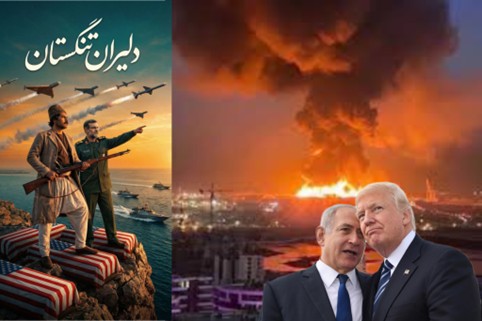
Continuing our topic from last week, as we saw Iran came out of the war in a much stronger position, practically winning it. But in what ways. We have to see these aspects now, because with all likelihood Trump will commit to another gamble and try a land invasion against Iran, or something equally drastic.
Therefore it is important to see in which ways Iran won the previous war and what consequences this had for the region. Because if Iran stays standing firm after the next aggression, the shifts that have started will speed up soon.
Militarily
This is the most argumentative of all the viewpoints, as in many ways the Iranian state can be put in a light that it lost the war. At least from a strictly military sense. On which, no doubt the PR teams of Washington and Tel Aviv are feverishly working, to polish their own image.
Indeed, the level of destruction in the Iranian army and police bases, the defense infrastructure, the civil institutions was massive and even residential areas were heavily bombarded. And even much more so than during the 12 days war, it seemed that the American-Israeli warplanes were ruling the Iranian skies, with little to no resistance. It is also true that on very first day a number of key military leaders, including the Chief of Staff of the Armed Force and Commander of the Revolutionary Guards were killed, along with the Supreme Leader of the country as-Sayyid Hāmeneī. The country lost the head of state. And these losses kept mounting during the days of the war with a growing number of commanders and key politicians, like Intelligence Minister Haṭībzāde, or Secretary of the Iranians Supreme National Security Council ‘Alī Lārīğānī.
Trump also had exaggerated claims about this point, almost obsessively posting from time to time how much the Iranian fleet and the air forces were destroyed. And indeed, Iranian light frigate Dena previously returning from a courtesy mission in India was hit and sunk on 4 March killing 87 Iranian marines. On board an otherwise unarmed vessel, on international waters, breaking all international norms. Trump also claimed in these posts that the Iranian airspace dominated and the Strait of Hormuz under American control. Overstepping not only that dozens of extremely expensive American and Israeli drones were shot down, but also a number of American planes as well, and even an F-35 got direct hit by the Iranian air defenses. But particularly his remarks about Hormuz shows clearly how little Trump can be trusted about these claimed achievements. Because even though several short and edited clips are regularly showed about allegedly Iranian vessels stricken and there are claims about the total destruction of the Iranian air forces, there is enough evidence to doubt that.
It is very significant that even though a large number of vessels was concentrated into the Gulf region months before the war was started, including two aircraft carriers, they never dared to get close to the Strait of Hormuz. And more than two weeks after the ceasefire, still the Hormuz is one of the biggest matters of debate, meaning the regardless all attempts, Washington could not, and still cannot open the Strait with military power alone. And how much was navy and the air force destroyed? Several videos shared by the Israelis and the Americans themselves prove that they are often hitting 3-D painting, or just recycling older images.
Similarly the story of an Iranian F-5 warplane penetrating American Fort Buehring (Magyar) is only now coming to light, with an indication that much bigger revelations are coming. The story is that a 60 years old Iranian plane managed reach the base in the early days of the war despite the air defense systems, to bombard it and return safely.
Later Iranian videos from the end of the war also showed that most of the Iranian planes, though undoubtedly very old, are still intact in underground facilities, waiting for not right time to be used. And even though some of the Iranian navy’s bigger ships, which are difficult to hide, are probably stricken, some even presumably sunk, Tehran’s real sea power are the thousands of small speedboats specially designed to overwhelm enemies. And their deterrent power works, as something still keeps the American fleet far away from the Iranian shores.
All that, however, is just on part of the story. Iran not only managed to strike at Tel Aviv, or Israeli military bases and positions, but practically all American military bases in the Gulf, Iraq and Jordan were paralyzed. Though many of the details were known from Iranian sources with satellite imagery as evidence, by now even CNN started to admit the level of destruction at these bases.
The only American bases that remained intact are those in Türkiye, with only one having significant support capabilities for an air campaign. All the others were constantly bombarded for a month, practically on a daily basis, taking them apart in pieces. Which makes Washington’s claims of only a dozen or so lost troops highly dubious. And that is even significant now, as Washington is preparing for a land assault, the key support facilities are not only crippled – some taking years to prepare, while others beyond hope -, but proven to be vulnerable. Which can serve as a deterrent against a land invasion.
We have also seen that the success of these Iranian strikes are the missiles and the drones that were launched in waves, all coming from underground bases. But despite all the accumulated ordnance, the most developed stealth bombers and the most sophisticated “bunker buster” bombs, none of these bases was infiltrated by the spy networks, or penetrated by bombardments. That is for sure, because if ever such an operation succeeded, the internet would be all over with it, just like sinking the frigate Dena. And the Iranian armed forces have dozens of such bases with their own production facilities, which even after 40 days of the fighting kept up the paste of missile strikes. Meaning that whatever pressure was on Iran, it could keep up the intensity of its strikes with precision, and could even increase them. And in the later days of the war, more and more American planes were lost, not to mention the dozens of extremely expensive American and Israeli drones that are used.
It is true that the American and Israeli warplanes could enter into Iranian airspace and carry out heavy bombings, mostly due to their technological superiority and huge numbers, but the majority of strikes are coming from beyond that, from above Iraq, or the Gulf states, also using a large number of cruise missiles. Given the technological disparity between the American and the Iranian air forces and the large number of planes aimed to overwhelm the Iranians, it is not surprising to see that they chose not to fight head on. Rather, betting on a long war, picking off the Americans assets step by step.
It can be argued that Iran was largely beaten militarily, only its missile and drone strikes are hard to eliminate and cause an uncomfortable annoyance. The now surfacing Western reports and the fact that eventually Washington chose to return to negotiating without achieving any of its goals and without opening the Strait of Hormuz, all paint a very different picture. Tehran knew what was coming, took the beating, but hit back very effectively. And that is the point Iran performed the worst.
Internal politics
In the internal front the Iranian political leadership won an overwhelming victory, despite the assassination of many of its leaders, including head of state Supreme Leader as-Sayyid ‘Alī Hāmeneī. And that is a lesson coming from the 12 days war. The Iranian population, probably to the initial surprise even to the leaders in Tehran, took to the streets in marches supporting the state leadership. And from the very first day of the war until now, the marches are constant with large number all over the country, not just in few major cities. Because Iranian national pride was awaken, the people closed ranks to defend the state from foreign aggression.
It is also noticeable that during the 12 days war Iran lost a large number of key figures, mostly from the army. Despite that the armed force remained functional and highly effective, showing the institutional strength of the Iranian military. This time Iran lost its head of state, and in this case a theocracy lost of highest ranking religious authority. The worst possible has happened to Iran. Despite that the new Supreme Leader was elected fairly soon and all state functions continued to operate without interruption. Which now shows the structural integrity and strength of the state administration.
Ironically, the assassination of Supreme Leader as-Sayyid ‘Alī Hāmeneī even has its positive effects, as he was 86 years old. For long years the matter of succession was a sensitive issue. Both in the sense of who should follow him, and from the point of view of how to transfer power. Because it was feared that with American-Israeli pressure growing and their PR campaign combines with economic hardship having an effect on the society, such a power transfer would be an ideal time to strike Iran. However, now the supreme state and religious power was transformed to a new leader, much smoother than it could ever be expected in peacetimes, even two years ago. And this transfer was not only not problematic, it had a massive support from the people, giving very high level of popular legitimacy.
Similarly, all lost military and political leaders lost had their places filled by equally skilled successors. The significance of that is how much the Iranians state shows resilience, rarely seen even remotely similar in the Middle East. This is clearly not a “one many show”, like most Middle Eastern countries, but a deep rooted state administration. A system, not a “regime” of a tightly packed clique. And that is a very bad news for Tel Aviv, as assassinating leaders and their families and committing massacres building on the shock factor is the Israeli state mindset’s signature tactic. This is where they are good at, unlike the prolonged war Iran managed to force them into.
Regional reconstruction
The military and the internal political success, meaning that Iran could bare the initial shock and hit back very effectively, reshaped the regional political chessboard. Though the signs are telling already, the real significance will only become obvious years later, when Iran will fully exploit this reconstruction. Just like it happened with Iraq after 2003, and after 2014. This is the real success story of Iran during the war.
As indicated before, Iran launched massive and very successful strikes against all the American bases in the Gulf region, and several times upon the economy of the hosting Arab states as well, responding to similar aggressions by the Americans and the Israelis. Though these targets were always American comic interests, they are part of the local comic environment, and the implication is very clear, Iran can annihilate these states economically. That fact, the revelation that the GCC countries – expect Oman, which had a close understanding with Tehran and never joined the aggressive policies against it – are defenseless and their very survival is directly dependent on American patronage had a huge impact. Not that it was unknown. But this far the level of constant arms purchasing from the West and especially the U.S., the American bases hosted and the presumed financial-economic leverage they had on the West provided the illusion that the GCC is on relatively equal footing with Iran. While in the local mindset it was always pushed that Iran is nothing but harsh rhetoric, the obvious weakness of the GCC states was covered as if they truly possess military power that can serve as deterrent. The Iranian strikes crushed this illusion. Despite the constant Iranian strikes and their position that these are acts of aggression against them, not the Americans, there was not one single military action taken by these states, except one Emirati attack on the day of the ceasefire against the Island of Lārak, knowing that Tehran will likely not retaliate to give a chance to the ceasefire. These states did nothing, nor individually, nor collectively to respond to something that they kept claiming to be an act of war against them. Simply, because they didn’t dare, and they lacked the power to do that. They relied on the American military power that failed them.
So much so that it even created cracks both with their ties to the West and Washington in general, and amongst themselves as well. Oman was clearly not on board with the aggression. In reward it was almost entirely spared from the Iranian strikes, no Omani casualties were reported, and Iran does recognize Oman’s rights about the Strait of Hormuz, constantly involving it in the negotiations. Meaning whatever revenue Iran will get out of the Hormuz at the end of the war, Oman will get a share of it. Qatar and Saudi Arabia chose to be cautious and did not want to provoke Iran to any further conflict. Even though allegedly Saudi Arabia had the military force to actually step up. But they realized their vulnerabilities and pushed for reconciliation. However, Kuwait, Bahrain and most especially the Emirates – which consequently suffered the biggest amount of strikes – pushed and still push for further military action against Iran. Though dare not to participate directly. This means that now even the last resemblances of a unified GCC have fallen. Consequently, whatever comes after the war, age of Gulf dominance in the Arab world is rapidly coming to an end, as infighting will get out of hands and Iran will have an easy time to pick them against each other. One interesting sign of this infighting came recently in a revelation from the Iranian Parliament’s News Service Director Mehdī Raḥimī. According to his statements, certain state(s) hosting American bases asked Iran during the war to bombard the Israeli positions in the Emirates. Though he did not name the country, it was very probably Saudi Arabia. And of that is true, it would show serious cracks in the formerly unified Gulf position about Iran, and about America.
This massive change, however, was not only caused by the success of the Iranian strikes and the overall low efficiency of the American countermeasures. The American – and overall Western – behavior was not any less responsible for that. After few days the war started military and regional policy commentators in the Arab media, who were always very hostile towards Iran, suddenly started to attack Washington even more than Tehran. Because the American forces concentrated solely on defending the Tel Aviv regime, and some of their own bases, yet cared little about these Arab states. And even less about their image, looking ridiculous, as they spent trillions of dollars hosting American bases and buying American weapons, and now Iran bombards them with impunity, not even a shot being fired back. Even more embarrassing was that by all accounts Trump did not inform the GCC states about the attack, bringing them into the war, but then showing not the least interest to defend them. Th sum of this equation is that in such regional conflict the U.S. does not want to help, nor it really can anymore. And so, the policy of American orientation of the last six decades, and tilting towards the Tel Aviv more and more in the last two decades for survival is not a viable strategy.
Once again, the understanding of the danger of this American orientation is not new. After the fall of Iraq it was always clear Washington can do the same with any of these states, and in the last few years it was proven that Tel Aviv will never be restrained by the Americans. Two things, however, kept any idea of leaving this path in check and made the Gulf leaders, and the Gulf public convinced that there is no alternative. First of the utter faith in the American technology and military. Meaning that even if this path was not favorable, there is no alternative. American will always win, and thus survival means siding with it! The second, stemming from the first, was the equally total belief that Iran would never dare to launch strikes on the American bases. No one fights directly with the Americans, so Iran as well cannot, thus it will not, and so siding with the Americans will always ensures being on the winning side. At least against Iran. However, now both of these presumptions failed. Iran not only hit back. It hit back very very successfully. And here came the even more haunting realization that only now starts to sink in.
After spending trillions of dollars on American bases and arms, taking the humiliation of hosting all these bases, as an occupation and now being constantly bombarded being in the mercy of Tehran in a war that is fought for the sole benefit of Tel Aviv, these very expensive bases are crippled and someone will have to pay for their reconstruction. Soon Washington will force them to pay once again for the bases they paid for, never used, and brought them into a war that now cripple their economies. And during a massive economic crisis caused by the war, they will have to spend trillions again, just to have bases that have failed right now. Which Iran can still demolish anytime, as it is not about to go anywhere and not getting any weaker.
That is a serious shift in the regional thinking. Yes, the Gulf media is still pushing the anti-Iran position very aggressively, but it is not favoring America anymore. And the streets started to turn very aggressively against the American policies, while showing ever growing sympathy for Iran. The mindset has changed. Not yet for the leaders, though they have some serious rethinking to do as well, but for the people. And the leaders now have to be cautious how far they go against Iran, not only because of how Tehran might react, but that civil unrest might cause these states to collapse. And there are early signs for that, as in Bahrain and Kuwait citizenship is being revoked from hundreds, simply for showing sympathy for Iran. And with such draconian measures the unrest will only grow.
That is where Iran triumphed regionally. Not seen as a menacing force anymore, but a state that stood up against America, a state that has to power to do that, and that does not face a united front anymore in the region.
Economically
Though it might seem insignificant now, as there true results are yet to be seen, Iran triumphed economically as well with this war.
One small indication about the economic resilience in Iran is that despite the warlike conditions for a year now, and the war for a month and a half, the inflation did no skyrocket – anymore than usual, even somewhat less -, the currency did not collapse and no shortage of basic commodities has happened. That does not seem to be a major achievement for any state, hardly a bare minimum, but considering that this state is under the most meticulous and harsh sanctions for five decades and which had to divert significant sums to the defense industry, amidst a war and the constant bombardment of the basic infrastructure and industries is a significant feat.
The war also raised the oil and gas prices on the global markets, which is great news for Iran and Russia, and Iran might suffer from the sanctions, the need of oil is so big that these sanctions don’t work. And that is a problem of the present, not the future anyways. Because as State Secretary Rubio has just recently admitted, in five years the U.S. will not have the capability to sanction states.
The age of sanctions is coming to an end, even if at the end of the war no agreement achieved lifting these sanctions. The growing ties with China will eventually erode the effectiveness of these sanctions anyways.
And more significantly, with its new policy, Iran gained a new revenue source with controlling the Strait of Hormuz. It never aspired to do that, nor would have ever dared, but the war brought this opportunity and Tehran took it. The significance is not only in the steady flow of hard currency, which has its benefits, but that Tehran will have a grip on global economic trends, and a channel to influence the petrodollar system. Because if Tehran will ask for fees for the Gulf in serious sums, but rejects the dollar, it will undermine the role of dollar as a global reserve currency. It will not make it collapse, but will weaken it, which will have an impact on the U.S.-Gulf relations.