
The war started by Washington and Tel Aviv on 28 February came to an uneasy and loosely kept ceasefire almost two weeks ago, as announced for two weeks. Officially to hammer out the details of an agreement based on the ceasefire conditions Iran presented. Only that no such real negotiations took place.
The ceasefire timeframe came to an end this week, with a likelihood that the war will heat up once again. Only in the last second Trump stepped back and extended the ceasefire “indefinitely”, whatever that means for him, allegedly by Pakistani request. Though the Pakistani side never actually signaled that particular intent.
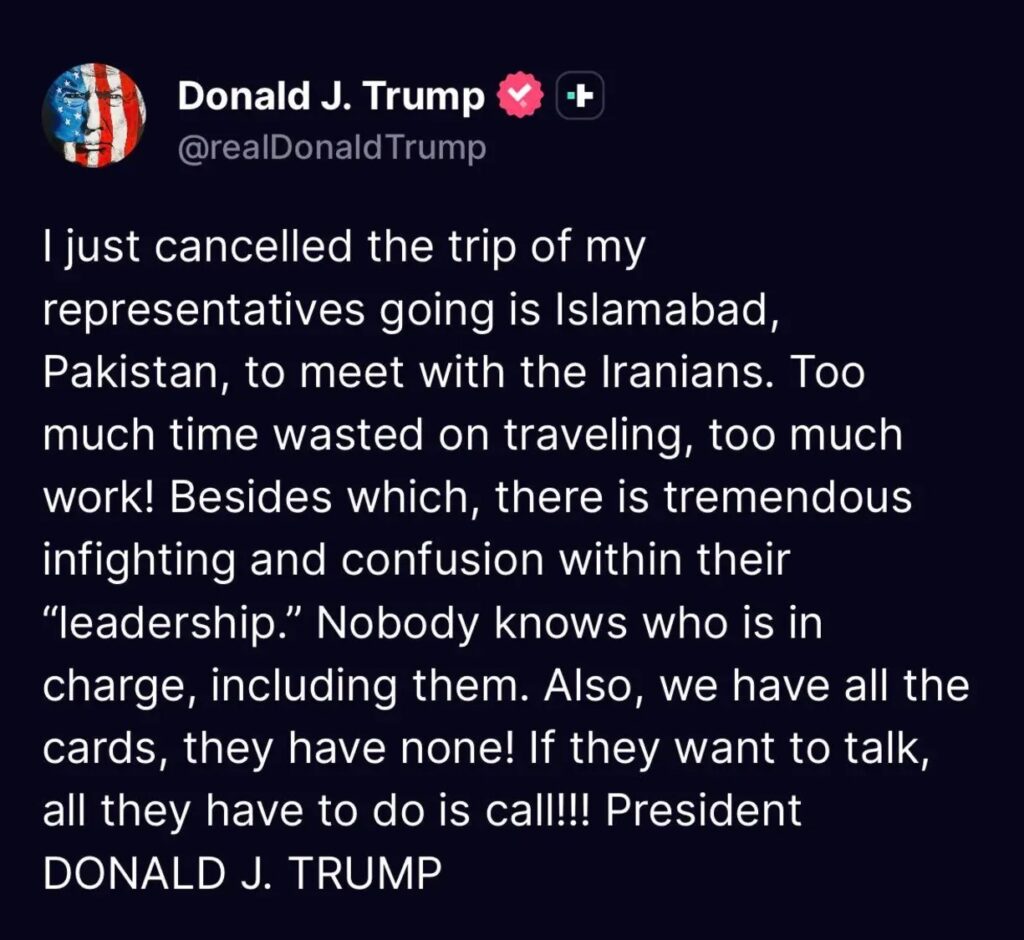
To add to the confusion, as Iranian Foreign Minister ‘Arāqčī started his regional tour to Pakistan, Russia and Oman, Trump suddenly signaled that the next round of negotiations might take place in Islamabad and will send his delegation. And while the Pakistani leadership was ready to facilitate such talks, in case Tehran was to agree to them, the Iranian never gave any signs that this was the aim of the visit to Pakistan. And bluff was called off on Saturday 25 April, as if Trump does not wish to negotiate, citing all sorts of unfounded claims, only after ‘Arāqčī had already left Pakistan. Whatever Trump say, which at this point has almost no face value, the embarrassing fact is that Iran is not keen on talking to Washington, at least not under threats and duress.
Which raises that question: Is war coming back soon to the Gulf region? Because in the fog of unsubstantiated claims and not clear objectives with the talks with Iran, and amidst a constant replacements at the top political and military leadership in Washington, the flows of military equipment is constant towards the region. Exactly as before the war started in February. To see where all this is heading, we have to assess the reality. The reality that so far Iran won the conflict, though in has not managed to bring the victory home. And thus, Trump is running short of options.
The deadlock
The reality is the after a month and a half of massive American-Israeli war campaign against Iran, and a failed attempt to claim a Venezuela-style victory trying to take enriched Iranian uranium in Esfahan, at the end Washington was left with four options to end the war. At least temporarily.
The first was further escalation. Meaning Trump would have fulfilled his vague threats with a devastating bombing campaign against Iranian vital infrastructure, the energy grid and all major economic hubs. Practically aiming to cripple the Iranian state. The problem with this option was that Iran is a huge country with a very complex and extensive energy sector and economy. Meaning it is very questionable how much this crippling effect can be carried out, though no doubt severe damages can be caused. The month and a half bombing campaign also proved that Iran’s underground missile bases cannot be seriously touched by a bombings, meaning that even with a “successful” crippling campaign the main asset of the Iranian military power would remain practically untouched. Yet in response to such a massive escalation Tehran would respond similarly, eliminating the energy sector all over the Gulf states. And since these states are much smaller and as proven, completely helpless against Iranian missiles strikes, Iran’s chance for success is much higher. And this escalation would still not open the Strait of Hormuz!
The second option was escalation with a land invasion against either Hārg Island, or some other border region from Iraq. After the failed Esfahan operation that was an even riskier option with all the mentioned complications still standings. And this option had no clear strategy, what to do after a “successful” operation creating a bridgehead, which the Iranian would just keep pounding.
The third, most horrific option was using nuclear weapons to cripple Iran’s energy sector and infrastructure, or against some other targets. This would have definitely had the shock factor that might force the Iranian leadership to unconditional surrender. But that was a huge gamble. Not only because Iranian sources even before the war clearly stated numerous times that they are calculating even with a nuclear strike, meaning they have contingency plans even for that, but because there was no plan what to do if the Iranians do not surrender. And the historic precedent is clear to see. During the war with Iraq in the ‘80s, when Iran was militarily far weaker, the similar shock factor was used in the form of chemical weapons – supplied by the West -, but that did not break the Iranians. And that was just the smallest problem with this option. Using nuclear weapons against a non-nuclear state that was not the aggressor and was not posing any existential threat to the U.S. would mean crossing all remaining international boundaries. The U.S. would become an outcast in international politics. Both international and internally the outrage would be unbearable. Also the radiation would hit the Gulf states as well, which are key American allies and a huge source of revenue for the American economy. Also that would become Trump’s legacy. A President that dug himself into a war he could not win, so he nuked a state that never attacked America and leave much of the Middle East with radioactive contamination. And let’s us not forget that the U.S. never really managed to overcome the moral burden of using such weapons against Japan in the Second World War, even though at that Japan was the aggressor. And beyond all that, it would still not solve the previously mentioned problems with escalation.
The fourth option was put a halt to the war, at least until some recuperating was done and a new strategy was formulated. And in the meantime possibly more favorable conditions can be created. The problem with this option was that despite Trump constantly signaling a wish for a ceasefire by the end of the second week of the war, Tehran was having none of it, unless it’s conditions were met. Trump could have just called victory and end the war unilaterally, just like he did in Yemen, but that would have not stopped the Iranians keep pounding the American bases in the Gulf and the Tel Aviv regime. Therefore Trump was left with the ceasefire option in a form of agreeing to all Iranian conditions, with a mindset of moving the goalpost later. By now it is clear that the strategy was: “Promise everything! Fulfill nothing!” Knowing full well that Tehran can hardly reject a ceasefire based on its own conditions. Especially if the alternative is a nuclear strike. But at the same time Trump was betting on the assumption that Tehran will not be able to squeeze Washington to actually keep its promises. So, at least to gain to time to at least rethink what to do and ease the pressure inside the U.S., Trump chose this option.
This is how the current phony ceasefire came to be. It is a very serious step back from the “unconditional surrender” objective announced in the beginning of the campaign, but that was far from being the biggest inconsistencies in Trump’s frenetic messaging.
The ceasefire that never was
The ceasefire announced after the bombarding camping was hardly ever kept even by Washington, and even much less by Tel Aviv, but at least the intensity of the war was cut back significantly. At least in the Gulf. And that would have meant a way towards comprehensive peace negotiations. But to see the impossibility and the treacherous nature of this ceasefire, we have to see what were it’s conditions and how much they were kept by Washington. Because that is exactly why Iran does not trust Washington anymore. That is why negotiations broke down.
According to the ceasefire conditions an overall halt of hostilities would set in for a period of two weeks and in all fronts, including Iran, Iraq, the Gulf states, Lebanon and Palestine. Washington would release frozen Iranian assets abroad, lift all primary and secondary sanctions, give up its demands for Iran not having nuclear technology, even enrichment and would agree to pay reparations for the war. Iran could also keep its control over the Strait of Hormuz, meaning collecting fees for its usage. Also very significant that all previous demands for Iran giving up its missile program, or limiting its contacts with the regional allies were abandoned. In exchange Iran would halt its strikes, open the Strait of Hormuz – except for military, or Israeli connected vessels – and agree to talks with Pakistani mediation, with an objective to end all pending concerns. And here the Pakistani role is also very noticeable. Also, according to the conditions, whatever the actual deal would be, it was to be ratified in a binding U.N. Security Council resolution, giving the biggest possible assurances that this time Washington would abide by the conditions.
It is important to highlight here the significance of the Pakistani mediation. Which is largely conducted by Pakistani Army Chief of Staff Field Marshal Āṣim Munīr. That is very important, since Pakistan is one of those countries where the army had a country, much more than the country having an army. Meaning the actual head of all armed forces is much more de facto leader if the country than any elected politician. The fact that Pakistan got involved in these negotiations, especially at such a high level is very significant to understanding what is really transpiring here. In all previous negotiations between Tehran and Washington a number of sides acted as mediators, from Oman to Italy, and many others were considered, like Türkiye. But never Pakistan. So, why now?
It is said that at the end of every war, the “peacemaker”, the side that sets and oversees the process is the real victory. Despite the closeness of the Pakistani elite to the British and the American mentality and ruling elite, the Pakistani state is the key ally and asset beyond all other to China. For a number of reason. So this Pakistani involvement means that China is heavily involved in setting the conditions. That is why Tehran agreed to this, even though all other sides were rejected before.
Despite the initially unbelievable acceptance of the Iranian conditions at the beginning, the true nature of the ceasefire soon became evident. First of all, Tel Aviv not only did not stop its war against Lebanon, but even immediately scaled up its bombing campaign committed horrific massacres, concentrating on Beirut and Southern Lebanon. And Trump reacted by claiming that Lebanon was not part of the deal. To which even the Pakistani mediators reacted with saying it was. Days went by and only after Tehran promised to react with missile strikes Trump agreed to react ordering the Tel Aviv regime to stop the massacres, which it never really did, only scaled back.
No frozen assets were released, and no sanctioned were lifted, even temporarily. That topic is not even present in the American discourse, signaling that there is not intention to fulfill that part of the deal. And Trump infamously ordered a blockade of the Iranian ports, effectively closing the Strait of Hormuz also by the American side. Which is hardly an appropriate tool to open it, which was the original goal to prevent a massive global economic catastrophe.
During the last week the Americans, though the blocked was only loosely achieved, even sized Iranian vessels, which itself of an act of aggression, hardly compatible with a cessation of hostilities. And since the Iranians have responded in kind, it is hardly effective either.
The only part of the deal that was kept – apart of stopping the direct strikes by and against Iran – was conducting the negotiations. Which had one round in Islamabad on 11 and 12 April, led by Vice President Vance on the American side, and Speaker of the Iranian Parliament Qālībāf on the other. However, the negotiations had no clear schedule by the Americans, they kept walking back on many of the conditions they had already agreed to in the ceasefire and no clear timetable. Meaning that the American negotiating team was not aiming for a solution, it was not serious.
This indicates that the negotiations are most likely are just a pretext to gain time, until another military operation starts. Because in the meantime the flow of American troops and military equipment to the Gulf region is not only constant, but accelerating. No doubt, the war will soon flare up once again.
Something, however, is still not set, or Trump hasn’t made the decision yet, as on 24 April the ceasefire period ended, but instead of starting the war once again, he unilaterally extended the ceasefire in the last second. Which puts the Iranians in a difficult position that even though they have not achieved their goals, they cannot go back to the war, not to seem as the aggressors this time.
Nonetheless, Iran is gaining momentum, even with this phony ceasefire. Its position is getting better. It has won the war, but still needs to harvest the gains of this victory. How much, and in which ways Iran won the war will be out topic for next week. But until than, much can change.
What is coming?
It seems that America needs to be humiliated further to finally give up this failed war. It needs a Vietnam! A humiliation on the scale when the public watched the fall of Saigon, or Kabul.
Will Washington play the same trick even for the third time in less than a year, pretending negotiations, only to start a massive campaign once again in the last second? At this point this seems almost certain. The flow of troops and weapons to the region clearly indicates a land invasion. That is exactly why by this time Tehran is ignoring the rhetorics and signals that in case Washington is ready to accept the terms it will talk, but otherwise will not engage in negotiations without a clear agenda. Its military production is constant, the people are called to rallies everyday to keep the spirit alive, and the key military and political leaders, including Supreme Leader as-Sayyid Hāmeneī are not appearing publicly.
One way, or another, Trump will very likely give in to temptation to end the crisis with war, most likely by starting a series of assassination and a land invasion. The assassinations are clearly indicated by the floating ideas in the American state owned press that there would be deep divisions in the Irnaians leadership, so they “only” have to kill those opposing a “deal” – by which they mean surrender – and patch things up with the acceptable ones. If that was followed by a land invasion, the Iranian forces will let them in to a certain point, favorably not to an island, but to border region. Here they can bubble them up and keep pounding them, bleeding them out. And at the meantime devastate the American allied Gulf state, which will be facilitating and financing the American invasion. Which will lay the groundwork for Iran’s regional positions after the war. This will be Trump’s political end.
The only alternative to this is a deal. Some sort of a middle-ground compromise. Which is not that likely, as Tehran cannot trust the Americans and cannot allow to fall for another JCPOA. It would need very solid guarantees for a deal, which is simply beyond Trump’s character.
In any case the Iranian leadership has one significant scenario to fear, just like a year ago. An internal political collapse, a large scale uprising, which would tarnish its position amidst a war, and make an American-Israeli “regime-change” war acceptable globally. This fear, however, is not significant now, and the leadership’s position improved exponentially compared to what it was a year ago. The people during the 12 days war, and in this recent war as well, took to the streets in massive rallies every day to support the government. Also the lost political and military leaders were replaced with great efficiency, meaning the state proved very resilient.
If the Iranian state remains intact at the end, which is the likely scenario at the moment, it will turn the regional equation around. And that started to set in the West. This is visible in the American public discourse. Trump says that the Strait of Hormuz is not important for America, it has oil and such a lockdown is only benefitting the American sales. The global economy will only tilt more towards the U.S.. His opponents, however, talk about the Middle East not being important anymore as the U.S. has enough oil, so why should they fight a war for the sole benefit of the Tel Aviv regime? The point is different but what is coming is clear. Washington will not have the same influence in the Gulf after this conflict. While Iran is there to stay. With more leverage.
The open questions at this point are the price of this result, and time it will take, and the level of destruction it will bring with it. The question is how much Iran can achieve its objectives and on what costs. But the overall result is almost certain decided.