

Sana’a broke through again and gained yet another major victory against the Saudi backed forces on the 14th and the 15th of November.
The policy of Sana’a since the war has started again this fall is to make announcements about operations that are politically, or internationally significant. Yet at the same time never talk about operations that sensitive and have massive consequences within Yemen, to hide the real intentions and let its enemies guess. So, just because we hear little about the developments of certain fronts by Sana’a that does not mean defeat, or withdrawal. It means that Sana’a is working on something significant.
Unlike Riyadh and the media outlets supporting it, as far as Sana’a’s military operations results talk louder than claims and daily events are rarely commented. And now, after heavy fightings along the southwestern coastline for almost two months, the events of the 14th and the 15th of November saw a breakthrough as significant, if not more, than the liberation of the western coastline and the Strait of Bāb al-Mandib in September.
The events of the frontlines
But what has just happened? Back in September the liberations of the coastal city of al-Mahā on 7 September was a major breakthrough and the collapse of the Saudi backed forces all along the Yemeni western coastline and in Ta‘izz Province. And so, by 11 September the Strait of Bāb al-Mandab and all the Yemeni islands on the Red Sea were liberated by Sana’a. The offensive came to a halt on 16 September and the front along the southwestern coastline was more or less consolidated halfway between the strait and the major airport and military base at Ra’s al-‘Āra. Due to the intensity of the fighting shifting to the coastline and the Saudi backed forces concentrating on retaking the Bāb al-Mandab – which was the politically most imperative goal for Riyadh -, the city of Ta‘izz was encircled by 4 October. Here the progress is very slow ever since, as Sana’a does not want to storm the city and cause massive street fights, rather a politically much more beneficial outcome. A triumphant overtake with public celebrations.
As Riyadh was concentrating on retaking the Bāb al-Mandab, it airlifted thousands of fresh troops, and all the mercenaries it could mobilize, mostly advisors from its allies and radical groups from Syria. It also mobilized its most capable – mostly al-Qā‘ida affiliated – mercenaries within Yemen for the same goal. And despite the repeated precision strikes by Sana’a, a significant force was amassed and supported by massive air strike campaigns the Saudi counter offensive started on 21 October. Though several unsuccessful attempts had been carried out, mostly collapsing within hours. The main goal was to take the city of Dū Bāb along the Red Sea, cut Sana’a’s forces at the Bāb al-Mandab and push towards al-Mahā. Despite repeated claims and sporadically cutting the coastal highway, the Saudi backed forces never managed to take Dū Bāb. The fights were particularly fierce around the city’s airport to its southeast and the surrounding area changed hands several times during the last two months.
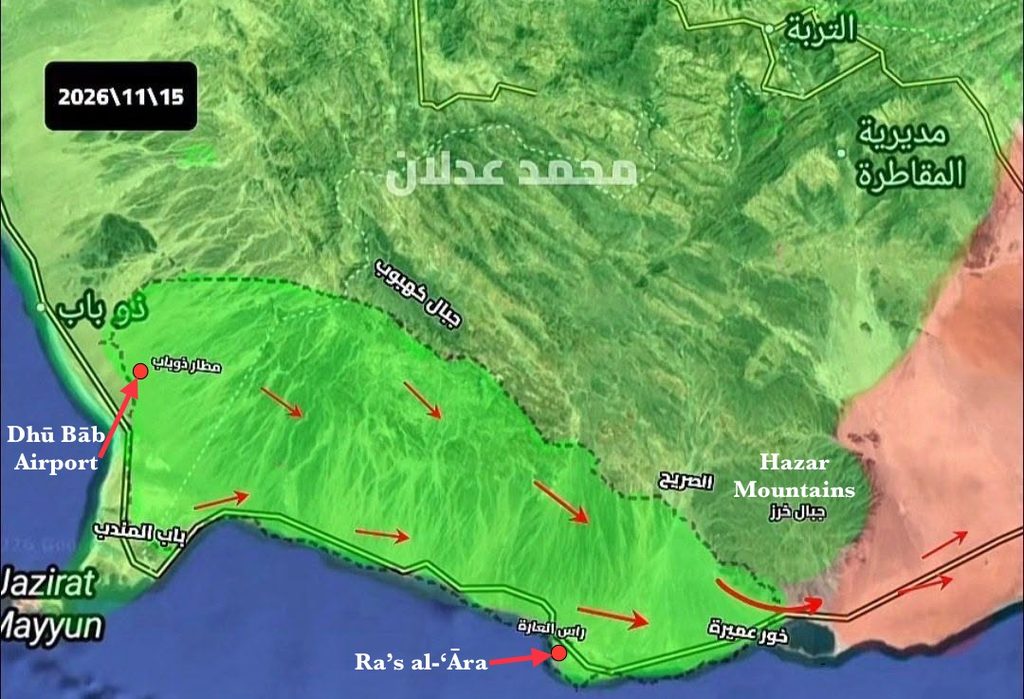
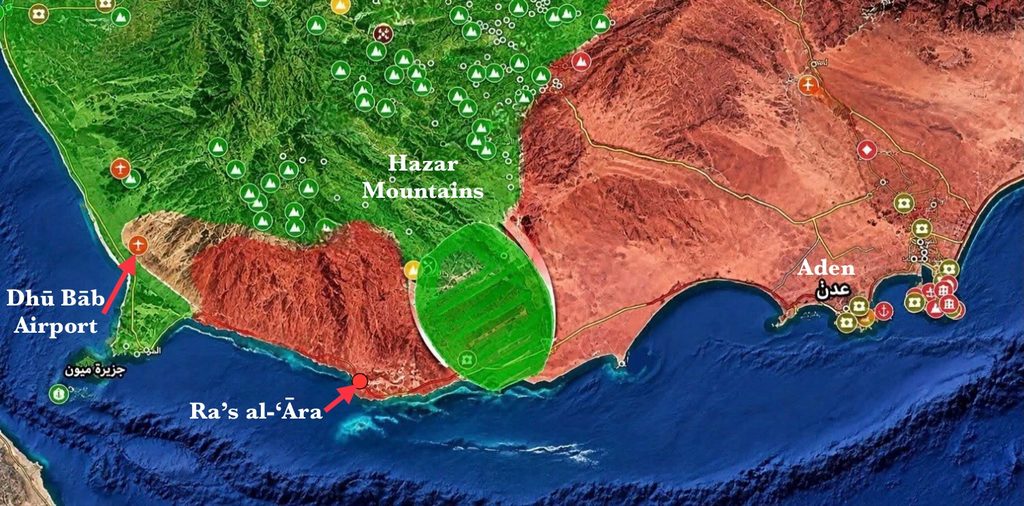
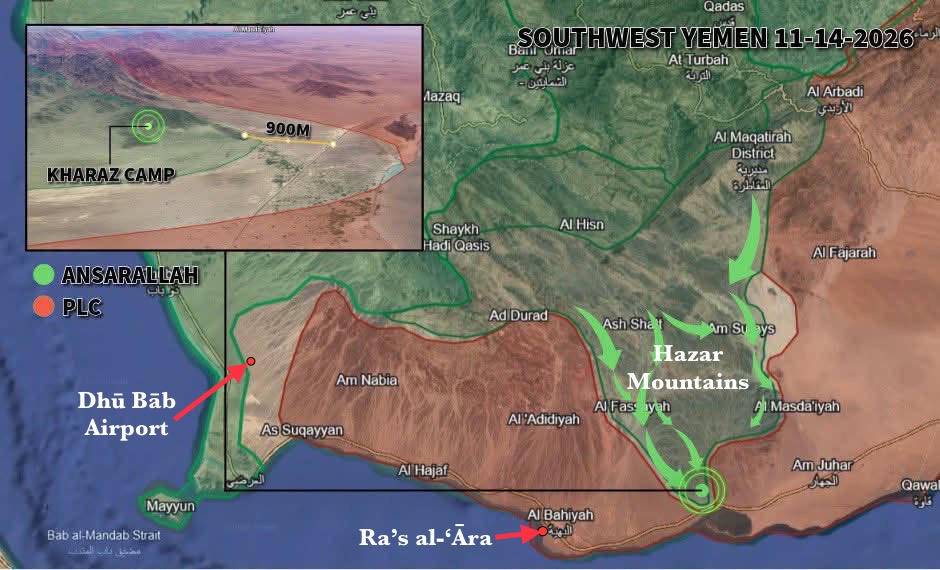
Sana’a forces, however, were not concentrating on the section of the front and let Riyadh believe that its control here is weakening. By now we know, they were working on a major pincer movement, which now yielded success. On 14 November the Hazar Mountains came firmly under the control of Sana’a’s troops. This mountain range is to the northeast of Ra’s al-‘Āra, the most crucial logistical base for the Saudi troops in this front. On the 15 the Anṣār Allah troops broke through to the southwestern coastline and the encirclement became complete. The confirmation about this encirclement first appeared on analysts’ and less reliable sites, but by the late hours of the same day the Western media also started to confirm the new reality, saying: “Yemeni government forces withdraw from area near Bab al-Mandeb Strait, Houthis in control”. Which is a tactic conformation of the reality. The Saudi backed forces amassed for almost a month collapsed, withdraw in total disarray and try to avoid capture.
How that happened?
The “secret” of breakthrough is lies in its simplicity. The Yemeni western and southwestern coastline to the north and the east of the Bāb al-Mandab is a flat terrain. Conducting large operations here would have been disadvantageous for Sana’a’s troops, as both the troops and the supplies would have been easy targets for the Saudi air strikes. Upon which Riyadh is basing its operations, as the sole field where its has a absolute superiority. Though it can make little tangible use of it.
However, the very same terrain make its easy for Sana’a to monitor the massive charges of the Saudi supported troops and to carry out precision drone and missile strikes against their columns and arriving logistical support. A tactic the Anṣār Allah is clearly excelling in. Along with massive mine fields and Saudi charges funneled by missile strikes, Sana’a’s troops drove their adversaries into several “kill zones”, especially around the airport of Dū Bāb, wearing these troops down. While on the other hand working on its own operation.
For the last two month Sana’a was working in this pincer, steadily moving through the mountainous terrain to the north of the coastline, as its troops are better suited for this warfare and less exposed to the Saudi air strikes. While on the other hand taking advantage of the use of small drones and detailed monitoring of enemy movements, likely received by allies. The objective was not the reach the Saudi backed forces logistical hub at Ra’s al-‘Āra and to be bogged down there exposed on open terrain, but to encircle them and force them to give it up. And this is exactly what has just happened. The biggest problem with this for Riyadh’s forces is not that the area was lost, despite the massive troops and material sacrificed for it, nor the loss of Ra’s al-‘Āra, which is not all that significant, but that there are no defense barriers built between this point and Aden. Aden became exposed. Though given the size of the city, it is very unlike that the Anṣār Allah would attempt a rapid push for the city. It is much more of a political blunder for Riyadh. The second one in two months.
The outcome
Sana’a is daily hammering the Saudi economy and its reputation as a stable, reliable state, as a regional power. It is being constantly ridiculed by an economically far less capable and internationally far more isolated enemy. That prompts constant rush decisions, which leads to blunders.
During the last months Riyadh was busy calling up all favors and mobilizing allies to fight the war for its benefit, which itself cannot win, nor contain. That produced the Mecca Defense Agreement with Türkiye and Pakistan, a mutual defense pact with Egypt, and recently a similar agreement with the al-Qā’ida led Ğūlānī government in Syria. Though Pakistan and Egypt sent troops to bolster the Saudi border and air defenses and some unconfirmed reports hint Egyptian troops deployed in Yemen – there have been Egyptian reports about Egyptian soldiers fallen in Yemen -, and despite thousands of radical mercenaries shipped in from Syria to the Yemeni fronts, Riyadh saw little benefit from all this. Because Pakistan and Türkiye don’t want to get involved with significant troops in Yemen, for a large number of reasons, while Egypt and the Ğūlānī regime cannot do much more.

Recently Saudi Arabia even had to suffer the humiliation, when its Pakistani and Turkish allies led Saudi Defense Minister Hālid ibn Salmān to Tehran to try to reach a settlement. In effect, Islamabad and Ankara tried to hammer out a deal between Riyadh and Tehran to end the war in Yemen, or at least arrange a face-saving ceasefire. There were no further news about this meeting, despite the official communique by Tehran that Riyadh must negotiate with Sana’a and Iran does not negotiate in its allies stead, or on their expense. Which is polite, but clear rejection.
The result of all these failed diplomatic moves and now the breakthrough in Southern Yemen is that Saudi Arabia seems all the more desperate and ineffective. Which will convince its allies further not to get involved in this war, much rather to push Riyadh for a settlement at any cost. It will also convince its allies and mercenaries within Yemen to abandon the war effort and seek a compromise with Sana’a. Which is becoming all the more pressing with fears that Aden is now exposed. And as an immediate consequence, this will speed up the liberation of Ta‘izz.