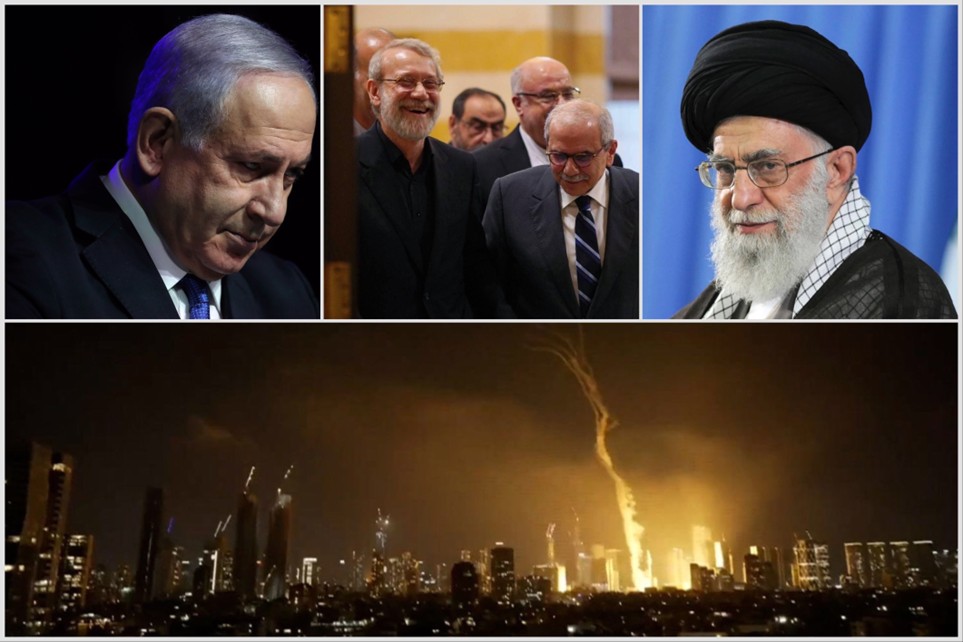
As we said last week, it seems inevitable that the war between the Tel Aviv regime and Iran would continue. All political and tactical developments in Iran clearly indicate that Tehran is calculating with an imminent war.
The foreign policy developments also show the same pattern. Significant visits by the Iranian president and the newly elected Supreme National Security Secretary Lārīğānī suggest that the last steps were taken to lay the groundwork in case the war indeed comes.
The three key topics where Iran clearly shows that it drew the red line are Lebanon, Iraq and the Caucuses. In these – highly intertwined – matters Iran can accept a deal to simply just keep its positions intact, but also very clearly shows that if the conditions are not met, it will go to war.
There are very few counter indicators left, where Tehran is waiting for a clear result. But none of these are game changing factors. Only matters, where Iran needs to obtain a definitive answer to finish the calculations.
The visit to Pakistan
On 3 August, so even before Lārīğānī was appointed to be Secretary of the Supreme National Security Council, Iranian President Pezeškiyān visited Islamabad. Which was very significant, as Pakistan very vocally and effectively supported Iran during the war in June, even hinting that in case of a nuclear strike by Tel Aviv Islamabad would retaliate in the same fashion. The meetings between the two presidents and the two delegations were very ceremonial and more than cordial, finally showing a good understanding between the two countries. Which is impressive, after all in January 2024 they were mutually shelling border areas of each other.
That was the first sign that Tehran wants to secure support from its neighbors wherever it can, and after the recent war Pakistan’s support is of paramount importance. Not only militarily providing support, or secretly even troops if needed, but providing a lifeline towards China. The other key matter is the border zone in Balūğistān, where separatist groups constantly cause security problems for both countries. This was a the source of the 2024 conflict between them. It is extremely important for Iran to secure this area in case a war erupts not to tie down security forces here unnecessarily, and not to provide a basis for intervention. Pakistan can provide a huge help in securing the border cutting illegal trade and arms shipments, and Islamabad itself has an incentive to do that.
During the visit by Pezeškiyān two matters were publicly agreed on. Guarantees for border security and increased trade cooperation. In fact to highly boost it. And this should not be underestimated with a country that is constantly under sanctions that being the key method trying to break it. So the meeting seemed very successful.
Though we cannot know what was really agreed upon concerning the military cooperation, some indications suggest that the meeting was not all what Tehran wished for. The Iranian delegation – at least officially – did only include Defense Minister Naṣīrzāde, a not particularly important member of the Iranian military establishment, but no key commanders of the Iranian military or intelligence services. And the Iranians did not meet key Pakistani generals, or key members of the famed Pakistani intelligence community. Given the importance of these institutions in both countries, this might mean good will by both governments, but not particularly close cooperation on the military front.
Nonetheless, the meeting was important securing good will and opening prospects for future economic development. Also securing that at the very least Pakistan would not be source of trouble, while Iran is engaged to the west.
The journey of Lārīğānī
The real indication that war is very likely coming came by regional journey of newly appointed Secretary of the Supreme National Security Council ‘Alī Lārīğānī first to Iraq and after to Lebanon. As he later said it, only to these two countries, because these are friends of Iran. Or in other terms, there are key Iranian allies in both countries, who need will be vital in a regional conflict, especially if that would be long.
Lārīğānī arrived in Baghdad on 11 August. He met with the Iraqi President, the Prime Minister and the National Security Advisor, also signing a border security agreement. This shows how seriously the Iraqi government handled the meeting. Little is public about the precise details of the agreement and it is clear that Iraq cannot fully prevent incursions into Iranian territory from Kurdistan, but it is telling that Lārīğānī did not make any meetings the representatives of Iraqi Kurdistan. Nor he even made any remarks about it. From which it can be extrapolated that in case of a war and possible attacks by organizations active in Kurdistan – like the Kōmala – Baghdad is willing to turn a blind eye if Iran wanted to hit back across the border.
The meeting was also important, because recently Washington pushes hard for Baghdad not to legitimize the Popular Mobilization forces, which had been trained and equipped by Iran since 2014 and since then act as part of the Iraqi armed forces. It seems clear that sufficient reassurances were given to Tehran.
On 13 August Lārīğānī arrived in Beirut, also to hold extensive talks, meeting President Joseph ‘Awn, Prime Minister Nawāf Salām and Speaker of the Parliament Nabīh Barrī. He also met Ḥizb Allah Secretary General Na‘īm Qāsim, though practically nothing was published about the details of this meeting. The objective of this visit was very clear. The current Lebanese President and Prime Minister in almost total symbiosis are leaning towards the pro-American camp. So far they had little problem with the continued Israeli attacks deep inside Lebanon, or that the occupation forces are not withdrawing, but determined to fulfill all American wishes to disarm Ḥizb Allah. Which is not only almost impossible, but would leave the country totally defenseless against Tel Aviv, leaving dependent of American guarantees. Which have already failed so far.
This is a central matter for Tehran, as Ḥizb Allah is the most vital ideological and tactical ally of Iran in the Arab world, and so far its biggest success. For all these reasons Tehran cannot let Ḥizb Allah fall, whatever happens.
Lārīğānī came to try to persuade the Lebanese government not to try to disarm Ḥizb Allah and to find so sort of compromise, to boost the image of Iran, but also to reassure Ḥizb Allah that Tehran will not stay idle in case of a confrontation. He also gave an hour long interview to Lebanese channel al-Mayadeen, which summed up Tehran’s view about the region, and especially about Lebanon.
From the reactions it can be puzzled that the Lebanese leadership is concerned about what Iran might do, but nonetheless doubled down on its position that Ḥizb Allah must be disarmed. Saying a shy, but clear no to any compromise.
The result is now clear. On Friday 15 August Ḥizb Allah Secretary General Na‘īm Qāsim in a televised speech clearly stated that the government has to change its position and that the movement will not hand its weapons over, even if that means confrontation. So far since the direct war ended in November with the Tel Aviv regime Ḥizb Allah was very much supportive of the government’s initiative despite all its shortcomings, and in theory was willing to go along with the disarmament plan dispute knowing full well what it means and what this government wants, only stating that the government should first achieved the total withdrawal of the occupying Israeli forces. Which was practically never even attempted. This puts Ḥizb Allah in a position that the government seems weak and only fulfilling the American demands. Which are growing, even openly threatening that what happened in Syria can spill over. And there have been regular border skirmishes.
Ḥizb Allah also knows that the Lebanese government cannot disarm it, but it wants to avoid a civil war. Now it got reassurances from Tehran and it is time for the Lebanese government to back down. Which so far, it doesn’t want to do.
The matter of the Armenian corridor
The recent memorandum signed by Armenia and Azerbaijan in the White House in theory paves the way for a peace agreement, but even until then establishes a corridor between Azerbaijan proper and its exclave in Nakhichevan. What concerns Iran is not the end of the conflict between the two neighbors, but that the corridor is leased by Washington for 99 years and an American company would be the logistical provider for its development. Meaning that the US would establish a presence built on Azeri and Turkish ambitions and practically nonexistent Armenian state control, right next to the Iranian border. Meaning a rapid military buildup. And that is where Tehran reacted the harshest.
On 9 August senior advisor to the Iranian Supreme Leader ‘Alī Velāyatī stated that “with or without Russia Iran will block American corridor in Caucasus”. Very clearly saying that Iran is ready for a direct war against probably Azerbaijan not to allow this American presence. And here Tehran is clearly not talking to Armenia, with which it has excellent relations. This message is to Washington not to try to encircle it, or try to cut its connection to Russia.
On 14 August Armenian Deputy Foreign Minister Vahan Kostanyan visited Tehran to diffuse the tensions and stated that no third party forces will be deployed along the Armenian-Iranian border. But knowing the desperate situation of Armenia now that might not be enough of assurances.
It is very clear that Iran feels the mostly American attempts to push its influence back in the region significantly and encircle it, possibly setting the grounds for a renewed Israeli attack. And if it understood this way in Tehran, this area can also be the place where the war breaks out. Thought Iran is understandably cautious, as it has cordial ties with Armenia, which should not be wasted, while an aggressive stance against Azerbaijan would invite the anger of Türkiye. With which tensions are high since Ankara occupied Syria.
The last few remaining counter incentives
There are very few questions left that the “peace camp” in Tehran is still trying to sort out hoping that success a positive outcome might persuade the leadership to postpone the confrontation.
One, as we see is that Russia’s behavior is still dubious. And after all what had happened in Syria in December there is obviously no full trust in Moscow. The opinion of Moscow is important in two key matters. The first is the matter of the Zangazur corridor through Armenia. Which is a more direct threat to Iran, putting American troops right next to the Iranian border with direct NATO support line through Türkiye and in a country where the government is weak and Iran has practically no internal allies. Iran clearly stated that it will foil any attempt for a military buildup next to its border, with or without Russia. But it is clearly better with Russian cooperation and it is still not clear how Moscow will deal with this matter. It has to wait until the Putin-Trump meeting ends in Alaska, and Iran does not want to trouble the negotiations. The second matter is that whatever trust is still there, Moscow can still provide cutting edge air defense systems and supplies of missiles for these batteries. Given that Iran has a fairly developed domestic air defense industry and has by all accounts obtained support from China that is again not a vital matter. But just like the case of the Armenian corridor, it is simply more beneficial to have Russia support than not having it. Yet, it should no be understood that Moscow’s attitude either way changes the final decision in Tehran.
There is still the matter is negotiations with Washington, which is kept floating in the news some, even suggested to be direct, while on other occasions the idea is clearly rejected. What seems to be the case that Iran is probing Trump whether he really wants to talk, or just wants to mislead Tehran again. Because if it can be arranged that Washington would back down in Lebanon, Iraq and especially above all in Armenia and in the worst case scenario Tel Aviv would attack alone and be beaten back again that is much more preferable than an open war.
Obviously after what happened in June the last remains of trust between the two sides have evaporated, not like there were solid foundations for an understanding. But the events of the war, and especially how it ended have many opaque aspects that suggest that there are still rules between Washington and Tehran to be built on. After all, it was Washington that ended that war, though mostly to save Netanyahu from further embarrassment. It is true that at the end Trump ordered the use of “bunker buster” bombs against Fordō, about which the result are still very far from being clear. But at that day the two other Iranian sites, Esfahan and Naṭanz were not hit with bunker busters, but with Tomahawk missiles, which unlikely to have caused significant damage. But it is more telling that these two sites are absolutely not discussed in the media. Also on the last day, Iran hit the most important American base in the Middle East, in Qatar, and by not it has been proven to be a successful hit, at least partially. Yet the U.S. does not discuss this matter and wants no retribution for it, practically accepting not only that its base was hit, but also the message that way more serious damages could have been achieved. And all that somewhat indicates that while the American establishment might want war, Trump doesn’t and he wants to avoid it. Meaning there is a possibility to find a way fighting this war without the Americans getting directly involved. That hope is very thin and again, does not change the mindset that Tehran will defend its interests. But as long at it direct confrontation can be avoided, it worths a shot.
Also interesting that Tehran is still negotiating with the European troika, the representatives of Germany, France and the U.K. finding a solution for a nuclear deal on the one hand, and to avoid reinstating EU snapback mechanism sanctions. About which recently China very vocally expresses support for Tehran. Again, this is not a crucial matter for Tehran, since the supply and trade route to China have been secured, even in case of a major war. But it is simply just better to avoid these sanctions if possible, and not to increase Chinese leverage on the state. These EU-Iran negotiations seem to go nowhere now and surely do not affect Tehran’s decision. It is simply an incentives to wait.
In this regard it is interesting to see where the Iranian diplomatic efforts are not focusing. That is the Arab world, and even more noticeably the Gulf. It would seem logical that if Tehran was contemplating a war with Tel Aviv, obviously on a larger scale than in June, the position of the Gulf states are important. It would be beneficial if these states closed their airspace for sure against at least Tel Aviv, or might even pressure the Americans not to get involved. In this regard the rapprochement between Iran and Saudi Arabia seemed very promising. Yet since the war there seems to be no attempt by Iran to influence the Gulf states’ position. About that the interview of Lārīğānī in Beirut to al-Mayadeen was very telling. He stated that a good coordination between Riyadh and Tehran would be very beneficial and that is supported, also saying that the Gulf states repeatedly signaled to Tehran that they don’t trust Washington and don’t want to go along, nonetheless the security cooperation with the U.S. is essential for them. Meaning that Tehran has given up trying to persuade them. It is enough to see that they are not agitating for war, as was the case in the past three decades, but these states cannot be trusted not to surrender themselves to the American will. And the conflicting interests with especially Saudi Arabia in Syria, Lebanon and Iraq and by now so big that there cannot be a deal between the two.
All these factors show that in certain matters Tehran is on the position of “wait and see”. But none of these are vital issues that would absolutely prevent a war in one way, or would definitely trigger it on the other. These are just tactical arrangements until decision is made.
The scale of the confrontation
There are only two things that can prevent a large scale regional war to which Tehran is gearing up. And both of these have to happen. One is that Iran’s positions in Lebanon, Iraq and Armenia have to guaranteed. In Lebanon Ḥizb Allah cannot be disarmed and dismantled, and a civil war has to be prevented. In Iraq the Popular Mobilization must remain legalized and active with full force. And in Armenia the corridor between Nakhichevan and Azerbaijan must remain demilitarized not putting NATO assets there and not cutting Iran’s economic access to Georgia. The other factor is that some sort of convincing – might even secret – guarantees must be given that Tel Aviv will not attack Iran and its allies in the foreseeable future.
The problem is all developments point to the other direction. The Lebanese government seems determined to try once again to disarm Ḥizb Allah and Washington is pressing very hard for that. Given the fact that Ḥizb Allah’s forces are way more coherent and trained, possibly even better equipped than the Lebanese army this can only have two outcomes. Civil war, or that Ḥizb Allah simply surrenders. Two second one is out of the question. Meaning that either the Lebanese government back down and resists the American pressure, or a civil war would come, which very likely will get Syria involved, meaning Iran will step in.
And now this seems to be the most likely first domino to fall on the way for a massive regional war.