
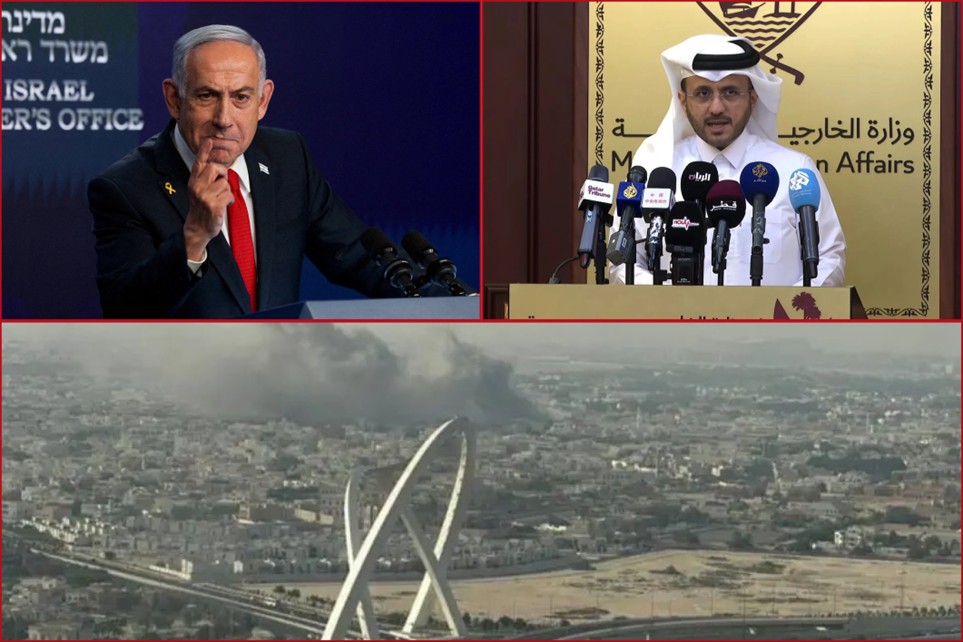
This week, on Tuesday 9 September it was Qatar’s turn to face the practices of the Tel Aviv regime. That day Doha was bombed by the Israeli war machine. And more specifically, one of the most iconic part of the Qatari capital, the Katara district, a city within the city, full of cultural and educational institutions specifically toned to bring the Western world closer to the Gulf culture.
However, Katara not only hosts cultural institutions, but also some of the diplomatic missions, many times those which are more sensitive to the international image of Qatar, including the Political Office of the Palestinian Ḥamās Movement. And that was the direct target of the bombardment. Allegedly to eliminate Ḥamās leader Hālid al-Ḥayya, but also the entire Ḥamās delegation that came to Qatar to negotiate the latest American ceasefire deal about Gaza. Drawing an eerily similarity between this event and the attack on Iran in June, when in the middle of the American led negotiations Tel Aviv launches a series of assassinations.
By the time of this attack only in this week Qatar was the fifth Arab country to be heavily bombarded by the Israeli military, following Lebanon, Syria, Tunisia and Yemen. Yet this event was surprising not only because all Gulf states have more or less good operational relations with Tel Aviv, but because so far as essential American allies these states seemed untouchable. Now it was proven that this presumption is false. Not even the most dedicated American affiliated regimes are safe from humiliation and direct military action against them, despite their continued appeasement policies.
What makes this event even more noticeable is that while hosting high profile Ḥamās members seems to be a red flag in the eyes of the West, Qatar was in fact not doing this as a secret, but as a service for the American diplomacy, mediating along with Egypt for almost two years to achieve a settlement about Gaza. Yet not only Tel Aviv evaded trying to sugarcoat the event, but immediately doubled down placating Qatar as a terrorist supporting state that should take action against the Palestinians, or will face similar attacks. And despite the outrage, Qatar received very little support from Washington.
The humiliation not just to Qatar, but to the entire Gulf region is enormous. Bringing up the pressing questions. How could such an attack occur? Which states were involved and to what level? And how will Qatar, a very significant power factor in the region, react to such a clear and blatant attack not just against its sovereignty, but against its positions as a major power broker?
The surprising attack
Since the attack the details about this attack are not getting clearer. They get murkier but the day. The reason is very clear. Three sides have primary information about the events, Tel Aviv, Washington and Doha. And none of them have the incentive to clarify what took place.
Tel Aviv understandably focuses on the reasoning why this attack was by its point of view necessary and justified, but does not wish to go into details, not to uncover military details, but also for the time being not to shame those states that were complicit. Because given the distance, such attack would not have been possible without the at least passive acceptance by some regional states and the United States. Discussing details would make it harder for Tel Aviv to continue such policies, yet keeping these secrets brings it a leverage against them.
The Americans have a very similar reason why they don’t want to go into the details. As main guarantors of the Gulf security and having the biggest military base in the whole Middle East in Qatar – the al-‘Udayd Air Base – they either helped this Israeli operation, meaning they betrayed Qatar, or they were surprised by the Israeli attack, meaning that Tel Aviv acts as a completely rogue state using the latest American military assets and the American security guarantees are useless. Which would mean that there is no point for these Gulf states for further funding the American military machine, if even the most basic courtesy is not payed to them.
And following the same logic, Qatar also does not want to dwell to much on the details of this humiliating incident, as it would make it seem weak military not being able to defend itself, but also betrayed politically. The details would show that its closest allies, the Americans and some neighboring states directly contributed to an attack against it.
What is known is that on 9 September downtown Doha was bombed a number of times, specifically targeting the Political Office of the Ḥamās Movement and the negotiation delegation within. Seven Palestinians and one Qatari security officer were killed. But the main target, Ḥamās leader Hālid al-Ḥayya survived the assassination attempt, though his son died. Some reports talked about Israeli warplanes cruising above Qatar carrying out the attack, clearly avoiding where they came from, while other sources indicated cruise missiles launched from Israeli bases. And as the most directly involved parties are not discussing the details, the public will probably never know.
It is somewhat suspicious that the main targets survived, given that during the last 12 months the Israeli war machine carried out a long list of high profile assassinations within Lebanon, Syria, Iraq, Yemen, and even in Iran. Many of these attacks were successful despite being way more complicated. However, a great number of these assassinations only succeeded after multiple attempts, while others in Yemen, and in Iran, for example killing President Pezeškiyān, or Supreme Leader Hāmeneī failed completely. So while it is suspicious that the attack this time did not succeed, it is not entirely impossible that al-Ḥayya was just lucky. Or it was simply a warming.
The immediate reactions
The first side to comment the attack was not surprisingly Tel Aviv, stating that the Americans were informed and President Trump personally gave the green light to the attack. Once again, just like about Iran, embarrassing Trump and the whole American government by suggesting that they would so casually betray such a close ally. In his Middle East tour in May Trump secured $2 trillion worth of investments from just the three visited countries, Saudi Arabia, the Emirates and Qatar. Most of these would be realized in massive purchases of American military hardware by these states. And Qatar topped the appeasement bid with donating Trump a brand new jet to be the new Air Force One, which worths $400 million. Now it seems that all this was for nothing. The overpriced military equipment was is useless, as the Qatari Prime Minister said that Tel Aviv used weapons that they could not detect. Even though the Israeli military’s full arsenal is solely American technology. And the appeasement angle buying American favor by investments also failed, if Washington allowed such humiliation.
The American reaction was, just like about Iran, completely contradictory and self defeating. In his immediate reaction Trump said that it was a bad decision, but he could not stop it and that he is not happy about it. Yet in his Truth Social later he stated that this was a decision taken by Netanyahu, not him, giving a very blurry explanation. On the one hand he admitted that he knew about it and somewhat defended the Israeli policy, but on the other hand distanced himself from the operation lightly trying to express solidarity with Qatar. Later on he pledged that such attacks would not be repeated. Yet he casually stepped over the pressing questions. How could he not stop such a step by Tel Aviv, and how could the biggest American base in the Middle East not detect and prevent such an attack? To explain this contradiction, though eventually making even more confusing, the White House stated that the US military informed Trump about the attack, and Trump informed the Qataris beforehand. The Americans’ credibility was further undermined by the Israeli statements. Almost immediately Israeli ambassador to Washington Yechiel Leiter stated that “we will get them next time”, while Netanyahu threatened with recurring attacks, unless his demands are met. And this clearly shows that Netanyahu is calling the shots, even over American foreign policy, while Trump’s words and promises have little impact.
Qatar was facing an impossible situation. On the hand immediately condemned the attack and hit back to all Israeli claims of terror support that Doha was engaging in an open and clear mediation for almost two years. Even serving the interests of the Israeli captives in Gaza. Yet on the other hand the Qatar leadership had to avoid any direct confrontation with the Americans, so could not show fury and not raise accusations. Not only because every Gulf states’ position and prosperity is completely dependent on American good will, but also because the only way to guarantee no such attacks would occur again is by winning over the Americans. But they had to say something. So eventually amidst the thin military rhetoric and fierce condemnation gaining the diplomatic support of regional states, all blame was vented on Tel Aviv. And about Washington, the Qatar Prime Minister concluded in dubious statement: “America did not cooperate with Israel about the attack”. Though he categorically denied the While House statement about informing them before, explaining that the American call came ten minutes after the attack.
The scenarios of confusion
The political statements clearly does not explain what really happened. Not the attack itself, though many of its details would be interesting to know, but how we got so far. Which leaves us with a number of scenarios. And upon them we can elaborate on the possible responses.
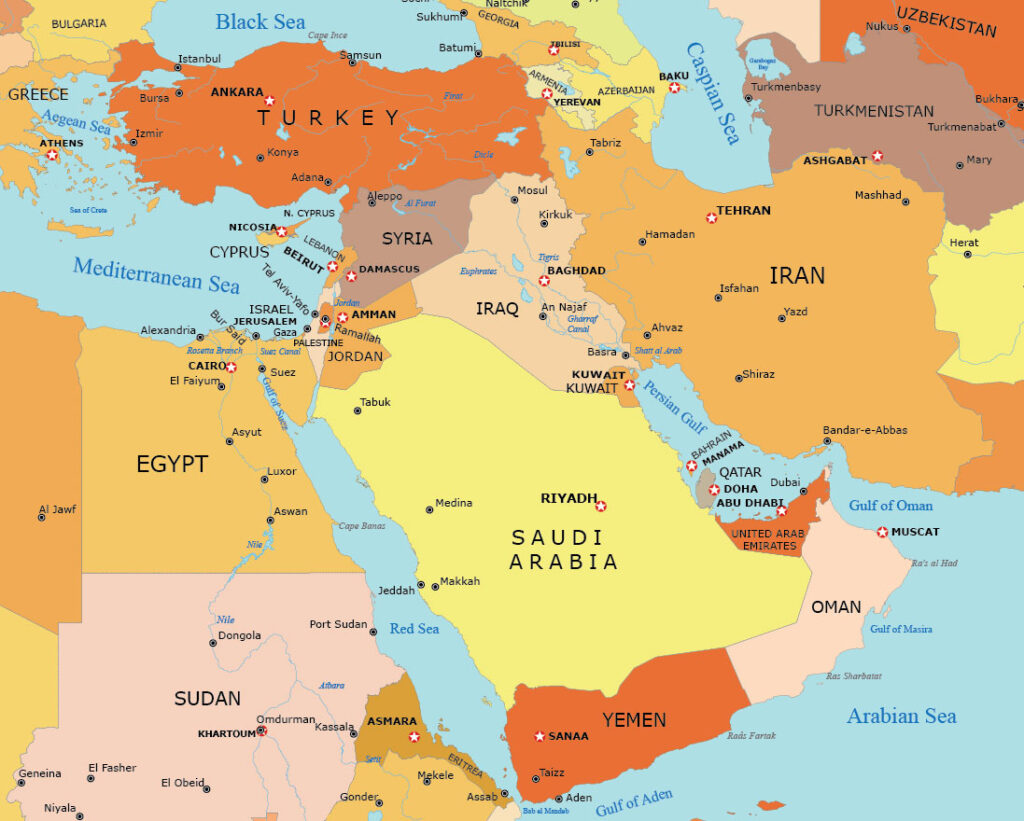
Either missiles were fired, or warplane flew over to Doha. Based on the nature of the attack the use of warplanes seem more likely, but there are no footages of Israeli warplanes carrying out the attacks and eventually the assassination failed. So there is a likelihood that “only” missiles were used. Either way, the Israeli military intelligence had to give precise details about the target. Since the beginnings of the Qatar mediation efforts in 2023, there have been multiple reports about Israeli officials visiting Qatar for the sake of these indirect talks, so the it is very likely now that meeting were used for spying.
Given the distance between Qatar and Israeli bases, however, a number of Arab states had to be crossed for the Israelis to hit Doha. All of these states host American military bases, and in several of them, the Americans have full control over the air traffic monitoring. Including Qatar, hosting the central base for all operations in the region. That alone completely excludes the possibility that the Americans did not cooperate with the attack. Simply because either missiles, or warplanes crossing over the American bases, any unidentified objects would have been shot down. Especially so close to Iran, which had bombed the very same al-‘Udayd base in Qatar this June.
Yet the matter is much bigger than that. Because while it is true that the American military has full control over the air traffic monitoring in the region with its bases and its fleet in the Gulf, the neighbors of Qatar – unlike some Arab states – have access to these data. So how come, none of them informed Qatar? Even by simple sightings, at least Saudi Arabia should have had indications about the attack, since because of the frequent Yemeni missiles against the Israelis they constantly scan the airspace for anything suspicious. Which raised the question: Could other Gulf states have been involved in the attack? Even “only” in the level that the American bases in their territories were used for it? If the answer is no that is a very chilling indication about their own security. And if the answer is yes, than we are facing a conspiracy.
The idea that Gulf Arab states would conspire with Washington and Tel Aviv for an attack against a fellow Gulf state might seem far fetched, we should remember that there is a deep rivalry between them. The feud goes back to at least 2013, when the entire Qatar leadership had to be replaced, and between 2017 and 2021 there was a full blown economic blockade by Saudi Arabia, Bahrain, the Emirates and Egypt against Qatar. Which in the beginning even had the possibility of a military intervention. And even though that crisis officially ended in 2021, there is still a very fierce power struggle between Riyadh, Abū Zabī and Doha about the spheres of influence in Sudan, Chad, Lebanon and Syria. So the idea that some of these states could be complicit in an American-Israeli attack is not at all out of the question.
And that is exactly why Qatar is so careful. Condemning the attack is one thing. Hitting back to Tel Aviv in one way, or another, even if the military option is impossible is another. But Doha must be very careful how much it can afford to antagonize its relations with Trump. Because if other Gulf states are part of a conspiracy to crush the Qatari influence in the region than Doha’s smallest problem is Washington. That is a matter of money, buying good will. But dealing with other Gulf states’ influence in Washington is a very different, and much more dangerous game.
The diplomatic response
Qatar mounted a very clear diplomatic response in two ways. A direct bilateral engagement with Washington, and a condemnation effort on all international forums, rallying the support of the regional states.
As for the direct engagement with the Americans, on Friday 12 September the Qatari Prime Minister travelled to the US to meet State Secretary Rubio and Vice President Vance. The following day he met directly with Trump in New York. It all seemed very cordial, but there were no details shared. Considering the overall very close ties between the two sides, surely there was no need for clarification. Doha wants some answers, but much more guarantees. Which so far hasn’t received.
Internationally Qatar brought the issue to the UN Security Council, where it got significant support. But that is unlikely to produce anything serious that would stop Tel Aviv from repeating this attack. Doha also called for an immediate energy Arab League session, also hosting Iran. So far Qatar has received a large number of solidarity statements from the Gulf and some Arab states, but the most vocal support came from Pakistan and Iran. Like so many times before, this summit will surely issue harsh rhetoric in solidarity with Qatar, underlining the importance of end the war against Gaza and condemning Tel Aviv. But it will not go beyond that. Simply, because there is no agreement, no unity and no strategy how to be friend with Washington and confront Tel Aviv at the same time.
And this all indicates that by money and some nasty tactics, Qatar will hit back to Tel Aviv on its own.
The humiliation for Qatar is an opportunity for Iran
The way Tehran reacted was especially noticeable. It tries hard now to win favor with Doha, on the hand getting over the fact the Iran bombed the al-‘Udayd base in June, but also to distance Qatar from the rest of the Gulf states. In June, despite all efforts by the Iranians to clarify that their attack against the al-‘Udayd Base was strictly to punish the Americans and had nothing to do with Qatar expressing the deepest respect, Doha choose to save face and project the image that it defended itself. It even produced a heroic looking, but rather comical short film, portrayed the Qatari military as the sole force that confronted the Iranian missiles. Something the Israelis couldn’t do.
Now, the humiliation is absolute. Two months ago Qatar portrayed itself as a military power in pair with Iran bravely confronting it, but now it was hit in downtown with weapons their radars “could not detect”.
Despite this the Iranian response was swift promising support even. In a phone conversation between Iranian Chief of Staff Mūsavī and the Qatar Minister of Defense the head of the Iranian military said that Iranian armed forces will not hesitate “to support the Qatari brothers”. The Iranian political establishment was just as vocal, also pointing it out to all the Gulf states that Washington cannot be trusted.
With this Iran wants to saw distrust amongst its Gulf neighbors and bring Qatar closer. Of course Tehran is not naive to believe that these states could get rid of the American overlordship. But now it has the chance to raise their suspicions that Washington is ready to backstab them, meaning that Iran should not be their biggest concern.
It is very noticeable that despite the huge rapprochement efforts with some success – especially with the Saudis – in the last two years, since the war in June Tehran turned away from these states. Iranian high ranking officials have since than visited Lebanon, Iraq, even Egypt and Tunisia, but not the Gulf. Which shows that Tehran knows how much they were involved in the war against it in June. But now, as the prospects of another war are growing, it is temping to turn these states away from supporting the Americans. And in this regard, the bombing of Doha might just backfire for Netanyahu.