

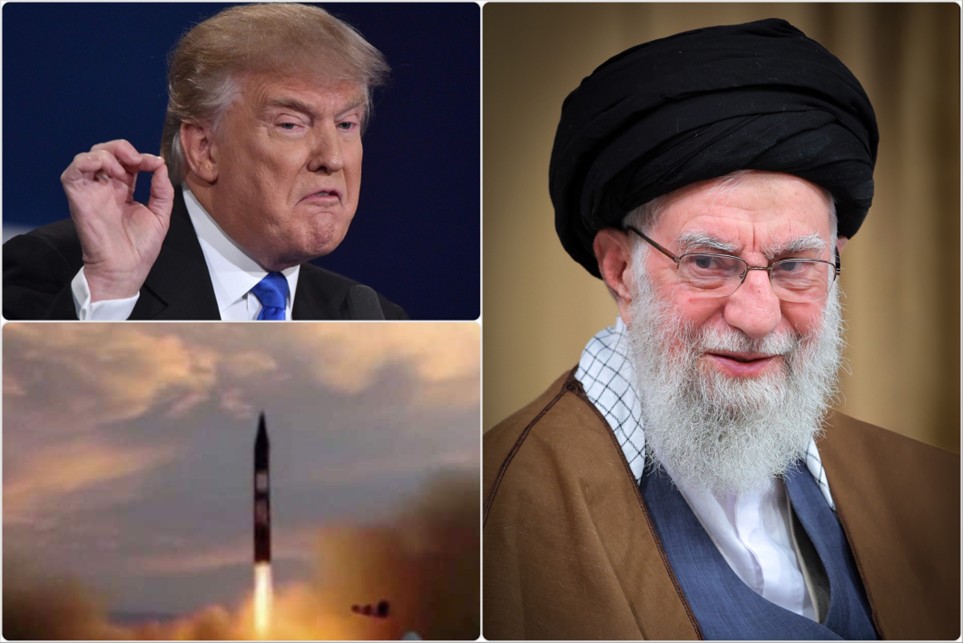
Since the second round of the indirect negotiations between Iran and the United States the global media interest seems blissfully ignorant about the continuous American military mobilization around Iran and the haunting possibility of a very massive war breaking out. With possible ramifications for the global economy.
There are sporadic news of talks and American military buildup, the possibility of a war marked as possible American military action, but nothing comparable to the war drums media sensation more then twenty years ago, when Washington groups its allies together to invade Iraq. As if the seriousness of the situation is not grasped.
On the one hand war seems to be inevitable, given the series of visits of Netanyahu to the White House, which was always followed by a major action, military or clandestine, against Iran. The size of the American military buildup, the constant American threats, Trump’s shortening deadlines for a “deal”, all this also indicate that the machinery is already in motion and there is now way to stop it.
On the other hand Tehran is constantly signaling that while it is ready to reach a reasonable agreement, it is absolutely prepared for war and does not shy away from it. The constant flow of Russian and Chinese military assets to Iran, about which there is very little reliable information, recently conducted joint naval drill by these three states right at the Strait of Hormuz, even temporarily closing it, also indicate that these would be no middle ground. There would be no limited war. If any military action is taken Iran will consider it a war on all fronts, an attempt to topple the political system in Iran and will fight a total war. And against all assets of Washington in the region.
It is like the last seconds of before the storm.
Can it still be stopped?
During the last two to three weeks reports about the accelerated American military buildup are constant. While major pullouts were taken from American bases in the Gulf, Syria and even Iraq, there has been a massive buildup in newly expanded base in Jordan, an American “ally” always reliable against Iran. What got even more attention was the arrival of the second American airplane carrier strike group, while one is already in the Indian Ocean. By most estimates around 35-40% of all American air power was concentrated against Iran.
Trump, beyond his usual vague hints, himself recently mentioned the use of the Diego Garcia Island, the most vital military asset in the Indian Ocean. Such a concentration means war. The simple cost of such a buildup is so heavy that it seems impossible to be simply a bluff.
This level of mobilization is so big, costs so much and takes so much planning and logistics that cannot be simply just called back. It is not just an carrier strike group to be turned around. And as recently Chinese satellite images showed, air defense assets and some air power was moved into the American bases into the Gulf states as well, despite the claims of the leaders of these countries that they would not allow their airspace, or land to be used against Iran.
So the scale is massive as an avalanche, indicating that the decision was already taken, all protraction is just due to finish preparations and find the most temping opportunity. That is the tone now the most hawkish elements of the American political establishment uses, like Lindsay Graham, or Ted Cruze. And so far after each visit by Netanyahu to Washington an attack was made against Tehran. In such a setup can Trump still call a withdrawal under the pretext of a “deal”? Considering that Netanyahu clearly doesn’t want to accept any deal, and the Iranians haven’t been willing to fall for it either. Irrational as it is, war seems definitely inevitable.
Why it seems improbable?
There are, however, plenty of indications why starting a war against Iran is not only irrational and reckless, but even impossible.
The only possible scenario on which the American forces can gamble in is a sudden strike paralyzing the Iranian state apparatus and with agents on the ground an insurgency can break out that would bring the Iranian state down. In every other scenario, just like in June, Iran will absorb the first hit, will show the world and more importantly the internal public that it was not the attacker, rearrange and hit back. And it can hit back very severely. Beyond its missile capabilities against the Tel Aviv regime, which are proven, it can hit back well simultaneously on multiple American bases in the region. And Washington cannot effectively defend all of them. Tehran back also use its missiles capabilities against the American fleet. This might seem unrealistic today, but the Iranian navy has never been seriously tested, no one knows its real assets. And the fact it has recently been revealed that the Revolutionary Guards can fire missiles even from underwater bases, and that recently Chinese satellites are proving precise real time date shows that Iran can reach the American navy. And here is a very significant different in objectives. Whatever the Americans forces are hitting, makes little impact on the Iranian capabilities and cannot be shown to the American public as victory. Since all that is “excepted”. However, even serious damage to any American ship, especially to a carrier, not to mention the possibility of sinking one, which the Iranians vowed to do, would be a catastrophic humiliation. At that point the American public would accept no excuse.
And finally, Iran can easily close down the Strait of Hormuz paralyzing global energy supplies. The consequences on global oil and gas prices would be devastating in an unforeseeable scale. And than public outrage would be Trump’s smallest problem.
But can a sudden strike scenario work? Very unlikely. Most infiltrating assets on the ground were spent in June and recently in January. Even the most complex strike scenarios are unlikely to assassinate all key decision maker in Iran, as the Iranian state is not a “one man show”, like so many in the Middle East, or Venezuela was. The loss of the Supreme Leader would cause outrage and bring the nation together, while the lost military leaders would be soon replaced with equally qualified ones. But even more, the defense doctrine of Iran is such that even in case of lost communications with the command centers, most underground bases are tasked with acting independently hitting targets. This cannot be contained. Unless there is a coup within the state leadership, or a combination of assassinations and swift insurgent takeover can replace the government, the state would not fall. And a protracted war is exactly the kind of war the Iranian political and military system is tuned for. For them any loss is martyrdom, while any victory is triumph. For the Americans any achievement is just a number, but any loss is inexcusable.
And the changing tone of Trump and sources leaking his visions, like Axios, might also indicate a changing course. Though Trump wants to increase the pressure with notions of shrinking deadlines, the sources started to talk about a “limited strike”. Meaning he wants a show, but not a real long war. He has no excuse for this war, and the White House doesn’t even bother to manufacturing one. More than twenty years ago preparing to invade Iraq the U. S. created a broad coalition and manufactured consent in the region. Today there is no coalition, and there is no regional consensus. Most regional states are at least publicly against the war, and while they are willing to cooperate under pressure they are afraid of the consequences. Even British Prime Minister Starmer refused to allow Washington the use of the Diego Garcia base for an attack against Iran, technically being a British possession. Which again does not mean that the Americans would not use it, but it shows that there is no consensus.
In such assessment Washington cannot bring down the Iranian political establishment, and a war would only harden their position.
Is war more acceptable for Tehran than a humiliating agreement?
Despite the very slowly progressing negotiations, the constant American threats and the military buildup Tehran seems to be adamant not to give in to the pressure. Even more so, Supreme Leader Hāmeneī recently responded to the threats openly, suggesting that Tehran will not shy away from war. The message is clear. A peaceful solution, an acceptable, clear and even agreement is possible, but anything less than a fair, strictly nuclear deal is not. If the choice is simply between war and surrender than the Iranian leadership chooses war. But why is that?
There are two very clear reasons for that. The first of that Tehran’s hands are not empty. It knows that it has tools to inflict very serious damages to the American assets in the region. It has the chance to hit the American navy, the American bases in the region and the global economy by closing the Strait of Hormuz. It can also severely hit back at the Tel-Aviv regime, as it was tested and clearly demonstrated during the 12 days war in June. At that time Tehran was surprised and many of its capabilities were hindered early on. This time Iran is fully prepared and spent the last seven months preparing exactly for this scenario. So Tehran is not bluffing and knows well that Washington knows that.
Yet the second reason is the complete lack of credibility of Washington in general, Trump himself specifically. In 2015 the JCPOA was signed and it was Trump to simply walk away from it. Trump started the negotiations last year, only to allow a military action in Iran in the middle of it. Trump also made promises to Russia, yet kept nothing of it. And what is even more convincing is that in 2024 and 2025 Trump was directly overseeing all the “ceasefire deals” of the Tel Aviv regime in Lebanon and Gaza, which was followed by constant Israeli violations without the slightest attempt to control them.
Meaning that in the Iranian calculation any deal is doomed to fail, whatever the concessions are. Nothing can prevent Washington and Tel Aviv to break the promises right after a deal, but the concessions will be an invitation for either more demands, or as excuse for war. Trump might think of himself as a great negotiator, but the Iranians are rightly famed as masterful diplomats. They are excellent at negotiating. So, they completely see through the tricks, when a “deal” offers them nothing. And their nature is such that is such case they are not afraid of confrontation.
The lessons of Venezuela
In the whole calculation the lessons of Venezuela might serve as a point of analogy. The two cases are very different, but the behavior of Trump is very similar and clearly that experience made him bolder.
It was the same constant military buildup, small scale operations, mapping the ground and a sudden strike taking out the Venezuelan leadership. The biggest fear, a protracted war claiming the lives of American soldiers and no results in sight was avoided. It was a showcase of American military prowess. Yet it is very telling what Trump was most proud of. “No casualties”.
Meaning that despite the action being reckless and absolutely illegal, public outrage was easily defused, since there were “no casualties”.
Yet the whole action was against an isolated and very weakened Venezuela far from any significant support, a shaken internal political structure and it was based on the cooperation of the internal collaborators. It is very telling that while Trump claims progress and changes in Venezuela’s behavior, there has been no political transformation. Iran is very different. The 12 days war was started with a surprise attack murdering a large number of key military and political leaders and even a bigger number was planned, which failed. The recent attempt in late December and January to cause civil unrest and achieve and internal collapse also failed. And now Iran is very much prepared.
That is not just about military preparedness, but the whole political system took precautions. There is not much talk about the details, but there are clear contingency plans for scenarios if the Supreme Leader was assassinated, the President, or much of the government. The loss of military leaders can also be contained, as seen during the 12 days war. If the initial surprise attack is absorbed, which Iran showed it can do, the retaliation can be devastating to all American assets in the region. In such case a bombing campaign will bring little result. The psychology of the Iranian nation is such that in such a situation the people will gather around the leadership even more, meaning that the only way to topple the government after that would be by land invasion. And that is something the U. S. is not prepared for, nor would the American public accept it. In short, there would be losses.
Will Trump really do it?
Given the whole picture, all the indications, the lack of a clear “winning plan” and the sheer prospect of how many ways this can go very wrong for the U. S. logic suggest that at the end Washington would not engage in war. It might try to create an opportunity to carry out a Venezuela style action to topple the Iranian state, but wouldn’t risk a war. Simply because if it did, Washington would have no control over the consequences.
A long, protracted war would close the Strait of Hormuz and the Bāb al-Mandab in one way, or the other blocking a significant part of the international energy supplies. And Washington has nothing to gain from a war, but any losses would cost Trump dearly. At a time when criticism about his warmongering is already growing in America, and around the world.
Given the mindset of Trump it all seems to be an oversized pressure tactic, bullying Iran into the corner to accept any deal. Which should end up in a meaningless agreement between Tehran and Washington, just to provide a path for both parties to claim victory, while avoiding an all-out war.
However, at the end of the day all such decisions go back to just one person. And these are human decisions. Just because it is highly illogical, unjustified and horrible risky for both the world and the personal future of Trump, it simply does not mean that he will not do it.
If he does, the first 48 hours will be crucial. After which the consequences will be catastrophic for the entire region, and possible even for the globe. If Ukraine was devastating, this will be nothing short of the Ukrainian tragedy.