
The significance of Somaliland
Though we needed to have a clearer picture about the regional equation, let see what be be the significance of Somaliland that could worth all the trouble and tensions about it.
What are the most common explanations provided by the legacy media?
One is that this will be the ideal staging ground for operation against the al-Ḥūtī government in Sanaa’s which managed to cause quite a surprising trouble for Tel Aviv, but now bankrupting its Red Sea port Eilat. That explanation is absolutely baseless and foolish, nothing more than a menacing threat. In the neighboring Djibouti the Americans and the French already have military bases, and Tel Aviv also has a military presence. Just like in Socotra, hand in hand with the Emirates. These bases are more than sufficient for any military buildup. But toppling the government in Sana’a, as the Saudis and the Emiratis have already learned the hard way, needs much more than just airstrikes. It needs massive land invasion with a constant flow of supplies prepared for a protracted war. Tel Aviv with two years of massive bombardment and an ongoing genocide could not subdue Gaza. Despite decapitating the Ḥamās leadership several times, the organization is not broken. The same can be said about Lebanon, where despite all military buildup, bombardment and picking the Lebanese sides against each other, the occupying forces could not advance more than a few kilometers and have no strong grip on the situation. They could only enter Syria unpunished, as there is a collaborative political system facilitating this and refraining from the slightest notion of resistance. Under such circumstances, while all these other fronts are not closed, and a new war with Iran on the horizon is it feasible that tens of thousands of troops would be deployed for a years long expedition hundreds of kilometers away with no reliable supply route? To fight a war in a very inhospitable environment against a well organized local population enjoying vast support? Wouldn’t Saudi Arabia, not to mention Iran have countermeasures to that? Would Saudi Arabia really welcome such presence by the Tel-Aviv regime right next to its most sensitive region?
Also let us not forget that while Tel Aviv’s forces already have a presence in Djibouti and Socotra, that is only sustainable because there is little local population to resist and there are partners to facilitate this. However, in Somaliland there is local population not at all supportive of the Zionist presence, and the troops present here would be ideal targets for all radical factions with the aš-Šabāb terror group at the top of the list, but also the Somali government lending a helping hand to these operations. With tens of thousands of troops present the success of the terrorist attacks will be almost guaranteed. And with an army already stretched to the limits and on the verge of breaking that would be the biggest foolishness.
Another explanation is that this way Tel Aviv would have control over the Strait of Bāb al-Mandib, the southern exit of the Red Sea. So, that could revitalize its trade and supply routes through the Red Sea. That is just as absurd. As mentioned, not just Tel Aviv, but forces allied to it are present in Djibouti, a state created to control this strategic position. Despite this even the Americans with way better capabilities could not break the government is Sana’a, nor the blockade they imposed on the Israeli trade. Why would another foothold in the same region change this?
It has also been suggested that the goal with the recognition of Somaliland is the have it as area for the relocation of Palestinian primarily from Gaza, but eventually from the West Bank as well. While this is also a frightening possibility, it is equally baseless. Not withstanding that there might be intentions for this in Tel Aviv. But packing up roughly two million people from Gaza to either planes, or ships is not a small task and would require huge manpower, even if no real resistance is expected. Which would surely happen. It would tarnish Tel Aviv’s reputation even more, especially considering that Somaliland is already a very poor and underdeveloped area with no means to sustain 2 million or more Palestinians. Which might be little concern for the Netanyahu regime, but would invoke massive international condemnation. And in short term would cause the collapse of the local government. After seeing the first ship leaving Eilat with thousand of Palestinians on board as slaves would cause such an uproar that there will be little room to carry out the whole project.
In short, none of the explanations offered so far provide any convincing argument. The recognition of Somaliland offer little benefit for Tel Aviv, apart from some propaganda argument that another “Arab state” recognized the Occupation as a state. But what does this recognition worth from a state no one recognizes, and what benefit the Israeli recognition has for Somaliland, when the majority of the regional states don’t recognize the Tel Aviv regime? The mutual recognition by two unrecognized state has little convincing power.
It is true that there are international examples, when the a state has very limited recognition, even only by just one state and still largely functional. The most obvious is that is Northern Cyprus. But such states are usually viable with a strong economic and military support of the recognizing party making it a practical colony. Another example coming to mind here is the Sahrawi Republic of Western Sahara, which is recognized by around 60 states and being a member of the African Union, even having an observation seat in the U.N., yet it matters little as it has no real control over the area. Somaliland does, but can the Israeli regime sustain it economically on its own, while without massive American subsides itself would be unsustainable? Does it even want that? With such a distance, there is no seems to be no real benefit.
A piece in the Emirati puzzle
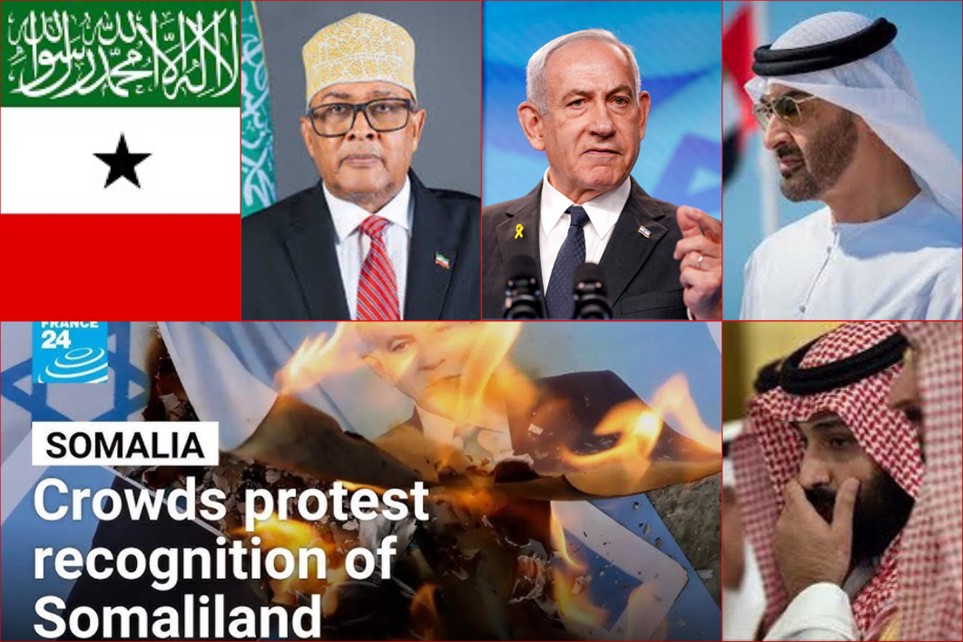
While there was a significant propaganda hype around Netanyahu’s recognition of Somaliland and some celebrations for it, it was less advertised that instantly mass demonstrations broke out there condemning the recognition. Thus showing that the is no undisputed sympathy for the Tel Aviv there. Also, Tel Aviv did not bother to bring along its usual partners, like Washington to this move. Yet, if this was something fundamentally important, surely we would have seen Netanyahu announcing it right along Trump and not taking this step alone.
The underlying reason for this move is the gradual development of the Israeli-Emirati alliance and its desire to divide the region amongst themselves. Everything to the west of Egypt would be Tel Aviv’s sphere of influence along with Palestine, Lebanon, Syria, most of Iraq, and parts of Saudi Arabia. Egypt would be a joint economic domain, while the Gulf, Yemen and parts of Iran in case it can be toppled would fall under Emirati control. And the most important step for that would be removing the barrier what is today Saudi Arabia. Either by making it join the Abraham Accords, which has failed and seems doomed. Or by breaking it apart. For which the UAE could not gain American approval, but Tel Aviv could. And while this might seem like massive conspiracy theory, in fact there are plenty of indications to it.
On Tel Aviv’s side, in a recent interview by Netanyahu he indicating working on the “Grater Israel” project. To which he showed no map, but the generally circulated maps show large part of Northern Saudi Arabia being absorbed. And taking control over the holy cities of Islam would be a devastating blow to all Muslim resistance. But the more interesting side is the Emirati one.
Egypt, which could be the biggest obstacle in such project is facing huge internal and economic troubles and is in desperate need of foreign investments. And recently the UAE increased its support buying whole swaps of land for touristic projects, like the one around El Alamein. And so, Cairo is more than cautious to criticize Abū Zabī.
The UAE is also present in the conflict in Sudan supporting the Rapid Support Forces fighting against the government. And this rebel group is gaining foothold despite all attempts to stop it, while Abū Zabī cares little about the international condemnation after the shocking massacres of the rebel group came to light.
We also see an increasing hostile attitude toward Iran as well, despite Dubai being the biggest economic outlet for Tehran to the global markets. Shortly after the 12 days Israeli war against Iran, on 13 July Secretary of the Iranian Supreme National Security Council ‘Alī Akbar Aḥmadiyān held a direct meeting with Emirati spy chief Taḥnūn ibn Zāyid, the mastermind of all Emirati clandestine operations, with little details shared publicly. What shows that this meeting was a bitter disappointment is that this was Aḥmadiyān‘s last foreign trip, less than a month later he was replaced and Tehran’s tone completely changed about Abū Zabī. Also remarkable that on 3 December the GCC issued a final statement of its annual meeting in which once again the matter of the three Iranian island the UAE claims for itself was brought up and with lengthy condemnation. A matter mostly not heavily pressed by the UAE in recent years. And naturally the statement was heavily rejected by the Iran. What is clear by that the now Abū Zabī is betting on the imminent collapse of Iran, after which would take these three island, possible even more Iranian lands, and take control of the Strait of Hormuz, over which it has not control today.
It is also important to note that Bahrain hosts Saudi and Emirati troops on its soil since 2011, when the Bahraini government almost collapsed, and since than Abū Zabī has a huge influence on the Bahraini policies. Which is clear by Bahrain alone joining the UAE signing the Abraham Accords in the Gulf. Kuwait, also facing internal problems, is heavily leaning on Saudi support and critical of the Emirates, but not in favor of Qatar and if the Saudi state fell apart would offer little resistance.
And finally there is Yemen, where the UAE is massively supporting the Southern Transitional Council (STC), which is not only pushing for breaking away restoring the former Southern Yemeni state, but also signaling readiness to joint the Abraham Accords. On 2 December, so roughly at the same time provoking Iran about the three small islands, the Emirati supported STC forces ousted Saudi supported South Yemeni President al-‘Ulaymī, took total control over Aden and launched a major campaign to Ḥadramawt and al-Mahra provinces. The STC practically took over everything in the south, reached the Saudi border, toppled the Saudi backed government and started pushing everyone aside. Except the al-Ḥūtīs, which would have meant a much bigger obstacle. And this is not a coincidence at all. A recent report with Brigadier General ‘Abd al-Ġanī az-Zubaydī, a military advisor in Sana’a stated the recently the UAE offered recognition to the government in Sana’a and also financial and military support, of the al-Ḥūtīs would bombard the biggest Saudi economy project NEOM with missiles.
This might sound wild, but the NEOM project along with all other similar projects of the Saudi Vision 2030 represent a nuisance for the Emirates as a huge rival slowing the Emirati economy and potentially undermining it in the long run. However, such a humiliating blow would undermine not only the rule of the Saudi Crown Prince, but also the Saudi state and make it impossible to block the Emirati attempts for breaking South Yemen away.
What gives remarkable credibility to this claim that on 30 December 2025 the Saudi forces did bombard two Emirati ships at the Yemeni port of al-Mukallā. And since than Riyadh very aggressively condemned and threatened the Emirates to leave Yemen, while continuing an areal campaign against the STC forces, pushing them back from the borders of the Kingdom. This development should not be underestimated. A power block just broke down and Saudi Arabia resorted to use direct force against Emirati troops with little regard for formalities.
This is where a process broke down. At least for now, but the STC in Yemen announced openly pushing for tearing Yemen apart and it shall be seen how Abū Zabī reacts to protect its vassal.
But this is where Somaliland is significant. It is part of a puzzle. Not a very important puzzle, but a juncture. By recognizing Somaliland as an independent state, Tel Aviv “breaks the ice”. If all goes well and Abū Zabī can dismantle most of the condemnations, this can be followed soon with recognitions by some lesser important African states on the Emirati payroll, a few European states, and after a year or so the UAE could casually join these states, effectively taking control over this area. This would help Abū Zabī to consolidate its hold over Southern Yemen, increase its support for its proxy in Sudan and eventually take control over Sudan as well. Which on the long term would offer a lane transit route bypassing the Bāb al-Mandib and revitalizing the Red Sea trade to Eilat, until Saudi Arabia is either forced to join and allow a direct lane support line, or taken apart.
Somaliland is not about Somaliland
As said, this step has little consequence for Tel Aviv. It is a cheap gesture, which can be really important for Abū Zabī, already largely controlling this area. This is part of a puzzle. A landmark in the formation of a new power-block, the official Emirati-Israeli alliance carving up the region into two spheres of influence. If all goes by the plans, Tel Aviv did a favor which costs it nothing and in the long run can bring massive benefits with the Emirati complicity. But if it goes wrong, it will only be an insignificant notion everyone forgets after a year, as if nothing happened.
In itself this is not a significant development. What just broke out in Yemen is much more important. But it is a turning point in the Emirati ambitions. And seeing the surprising sudden Saudi resolve, might have been the point where the UAE overplayed its cards.